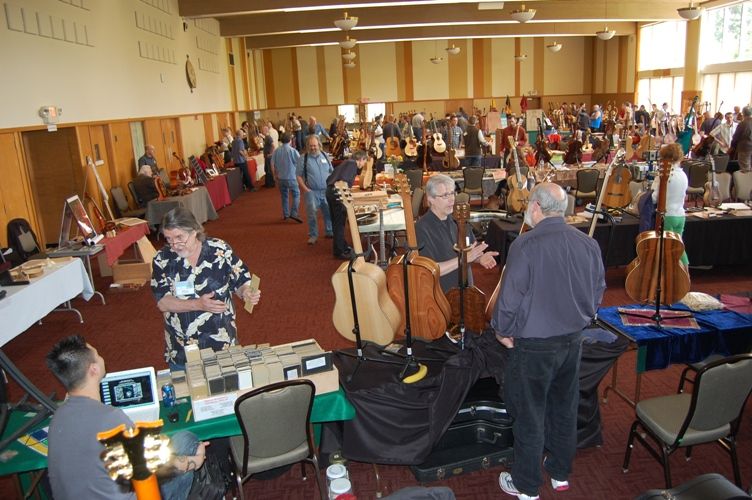
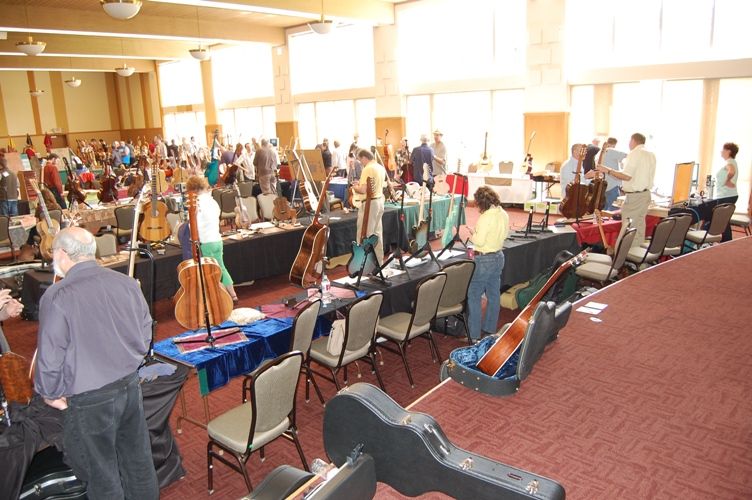
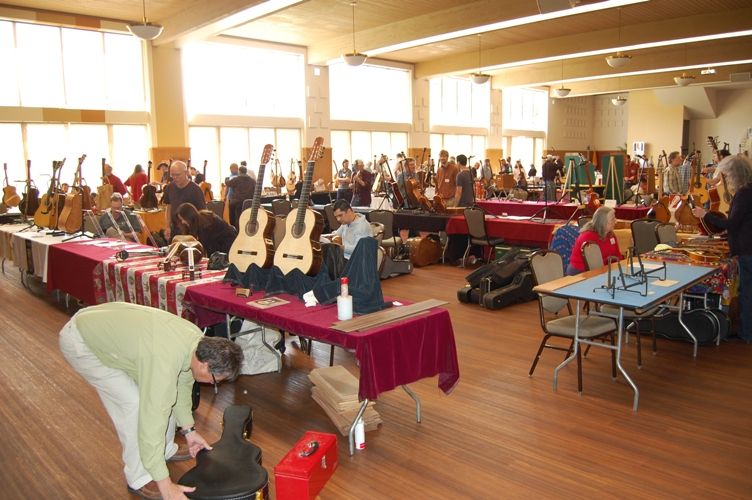
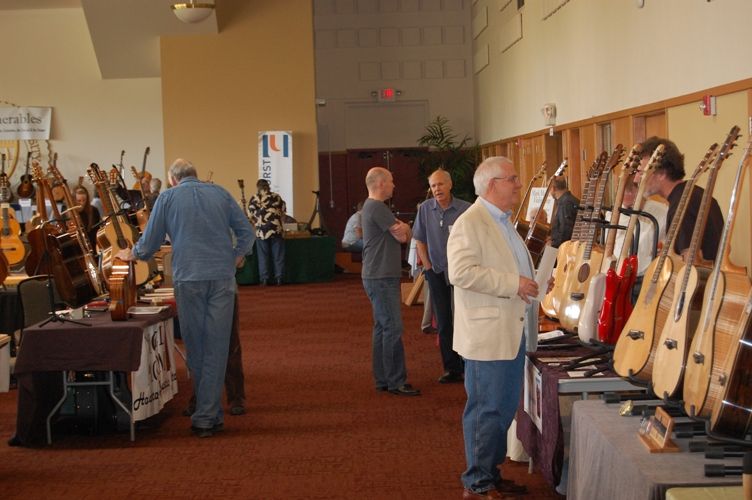
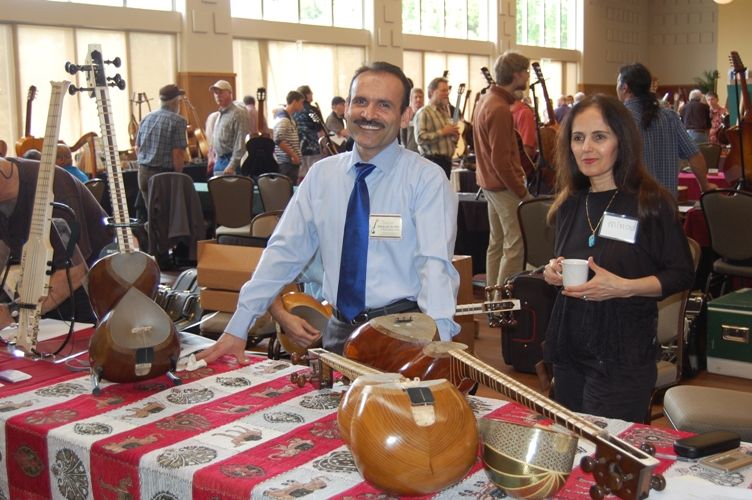
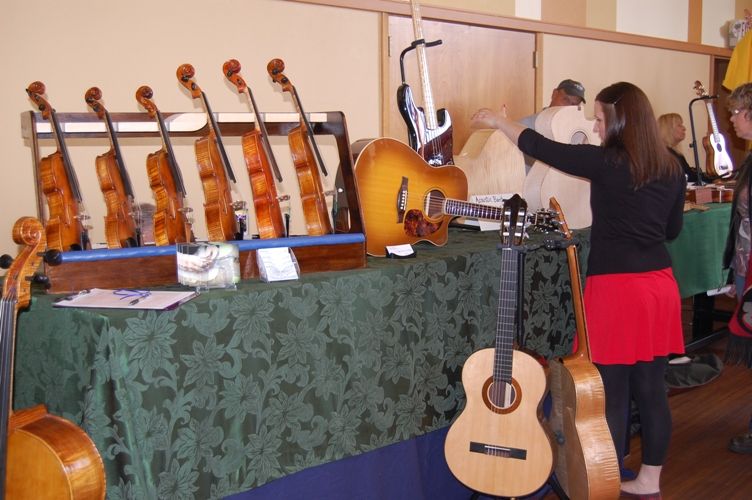
Here are some photos from the 2013 Marylhurst University Musical Instrument Makers’ Show: (Most were taken before the show was open to the public– these people are all the makers and vendors.)
It wasn’t all guitars and fiddles, as you can see. This couple makes Persian instruments called “Tars” (the larger ones) and Setars, (not “Sitars”, which have 30 strings…traditionally, a Setar has three strings, but apparently about a century ago, a tradition of four-string setars began.) That little thing to the right of center is a setar.
There were also two banjo makers, several ukulele makers, mandolin makers, an orchestral harp maker, and, yes, even a few fiddle makers. And every kind of guitar imaginable.
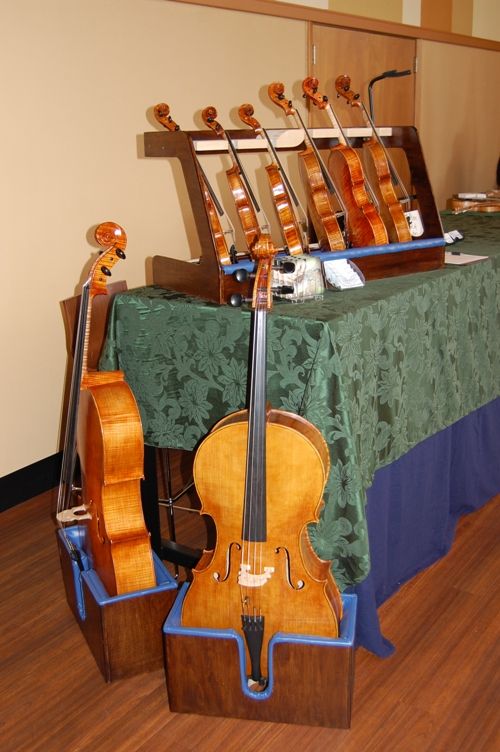
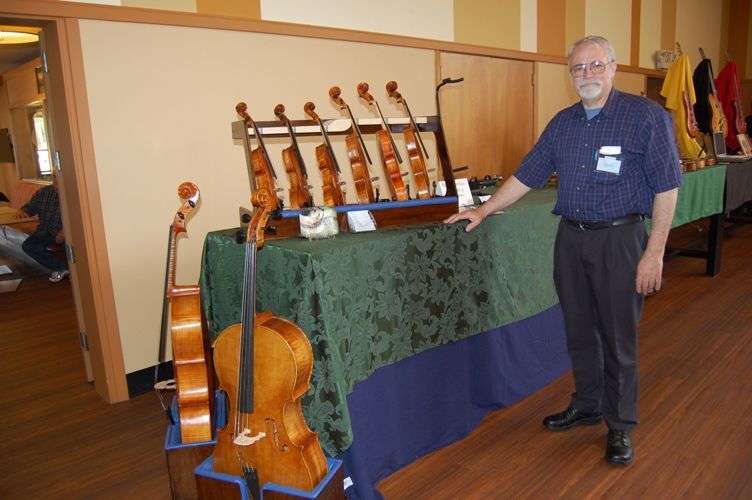
The table in the next photo was mine…I was sharing it with my son, who makes guitars. That worked out well. We had someone at our table nearly constantly.
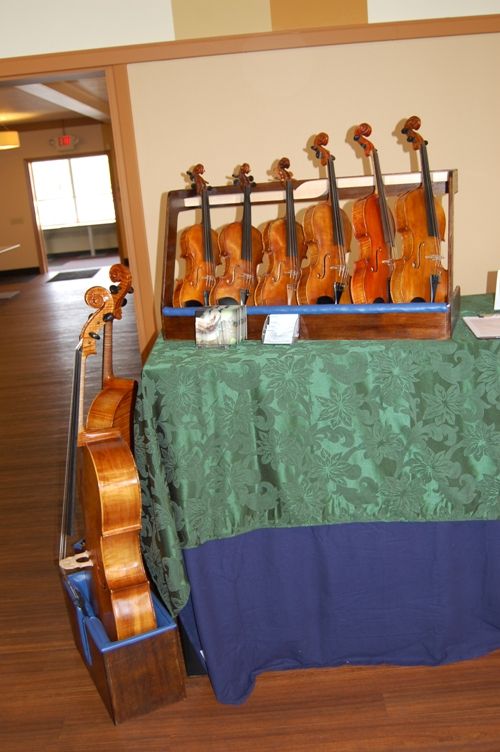
In the picture above, Brian, my youngest son, had not yet arrived. In the one below, his girlfriend was helping set up his display.
There were approximately 500 visitors each day…it was a pretty encouraging weekend.
The five string fiddle (left-most in the rack) sold, so that was nice, but unfortunately there were not very many cellists in the mix…only two stopped and played the cellos, but they really liked both of them. The five-string was the real star. 🙂
If you found this post helpful, please share with your friends!
Violins have been codified in terms of form, size, materials and tuning for over 400 years. Orchestras have 30+ violins, between which the untrained observer would have a difficult time distinguishing, let alone identifying as having come from a particular maker’s hand. And yet experts can frequently tell at a glance when, where and by whom that violin was made. And ALL of them have four strings (count ‘em): G, D, A, and E. No five-string violins in the orchestra!
The violas, too, have their four strings, always at C, G, D and A. They are less tightly defined, however and are all over the board in terms of size and shape. Some are so large that most normal-sized people can’t play them, and some are not much larger than a violin. But they all have those four strings, tuned exactly a perfect fifth below those of the violin. No five-string violas, either.
NON-traditional is OK, too.
Really, a viola works best at what it does, and a violin works best at what it does, as specialized tools…but when they are so close in size—indeed, sometimes overlapping—what prevents us from having one instrument that covers the full range of both? A five-string fiddle?
Well…that isn’t as easy as it sounds. The physical size of a violin is barely big enough to really produce the open G-string tone, so simply adding a low C-string will not work well…and the viola is almost too big to make good high-pitched notes, so adding a high E to a larger viola is usually not very satisfactory either.
Five-string fiddles specifically designed for five-strings
But it CAN work…with some tweaking. Honestly, probably a five-string fiddle would work best in the size of a small viola—say, 15”—or even 15.5”. But country fiddlers and bluegrass fiddlers, who are waking up to the desire for a fifth string, and a lower range, don’t want a “five-string viola”–they want their instrument to fit in a regular fiddle case—not a viola case. They want a handmade five-string bluegrass fiddle. (See Five-string fiddles)
What has worked for me, so far, is to maintain the “footprint” of a regular violin, but increase the depth of the body a little; lengthen the pegbox, obviously, for the extra peg and string; thin the plates just a little more, and deepen the bassbar a bit. I may try widening the center bouts just a little, too, sometime. But for now, I have a working model, with which everyone seems very pleased: it is very easy to play, has good balance across all five strings, a big deep bass end on the C string, and clear, strong high notes on the E string.
So, when a fiddler wants to be able to go low and growly, he/she can do so. When he/she needs a high end for some special sizzle, it is there. All in one fiddle case. A five-string fiddle case.
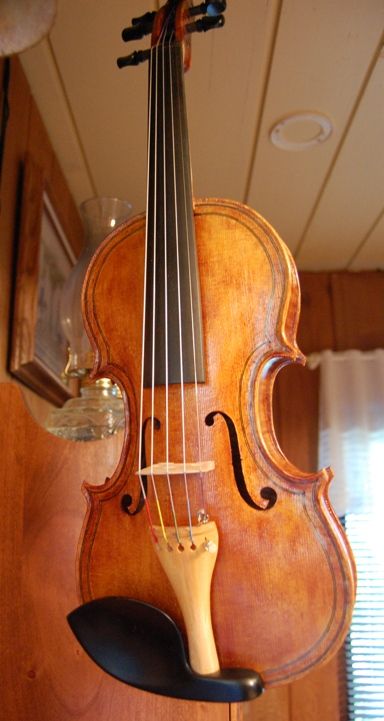
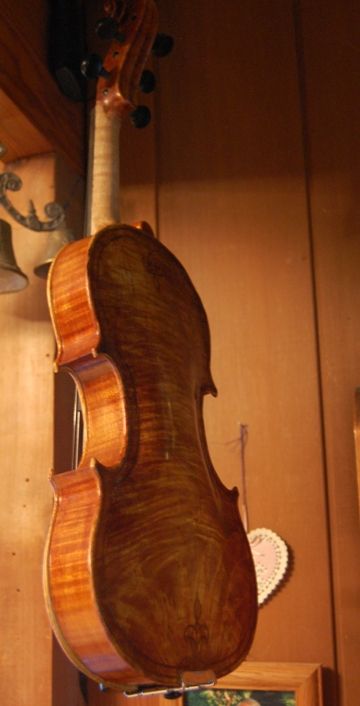
Front view of Oliver Five-string fiddle, by Chet Bishop. Sold.Back view of Oliver Five String Fiddle, by Chet Bishop (Sold)
If you found this post helpful, please share with your friends!
What is a “Luthier” (definition)? What is “Lutherie”?
So…What IS a Luthier?
The old French word simply meant “a lute-maker”. And his business was called lutherie.
“Loot-yeh” is pretty close to the French pronunciation. We Americans have a cheerful disregard for the pronunciation rules of the languages from which we borrow our vocabulary, so we typically pronounce it “Loothy-er”. The work of a luthier, lutherie, is usually pronounced “looth-er-y”
What does it mean Today?
The meaning has shifted, over the years, to cover the builders of all stringed instruments. Lute-makers are still luthiers, but so are guitar-makers, ukulele-makers, mandolin makers, and, of course, violin-makers. Violas, basses, cellos, five-string fiddles and dulcimers are also made by luthiers. Banjos, pianos, violas da gamba and harps, among others, are also built by luthiers. And the process of building and/or repairing stringed instruments is also called “lutherie”.
Usually when one is looking for a luthier, they are not looking for someone who made one guitar for a summer project, or something of that sort– they are looking for someone who is at least a competent worker, and who can reliably repair an instrument, without further damage. That takes some training and experience.
Some people have the privilege of attending a full-time, extended training program, or serving a term as an apprentice, under a master maker. This last is still likely the best training, although some fine schools are now available. Some cannot take the time from their established responsibilities to go away to school for an extended period, and learn from books, and/or piecemeal from a variety of teachers.
Workshops are now available in many parts of the United States, wherein one can begin to learn the skills to make guitars, violins, bows, etc. (Incidentally, one who makes violin-family bows is called an “archetier”… another French word.)
Resurrected Website: Bluefiddle’s West Wind Strings
A couple of months ago, in my befuddled, well-meaning, bungling way, I killed my website entirely.
The host was able to save it, but I had been in the process of changing hosts, so that was a bit awkward. I have switched from Joomla, which I was just beginning to understand to WordPress, regarding which I understand nothing…and have bought the requisite book: “The Complete Idiot’s Guide…” Sounds as though it was written for my kinda guy. A friend has reconstructed the site using WordPress, and has assured me that I will be able to master the new software. I trust he is correct.
New Five-string fiddle
I did complete one new instrument since I last posted: a five-string fiddle (sometimes called a “bluegrass fiddle”), using the wood from the Big Leaf maple log I had been given a few years ago. This is the first instrument I have made using that wood, and I am delighted with the look, response and sound. Here are a few photos of the new, handmade in Oregon, bluegrass fiddle:

 Follow